Selecting the best benchtop centrifuge begins with evaluating daily sample volume and routine tube sizes to match rotor options and adapters. Choice should prioritize required RCF over RPM Lab centrifuge, noting rotor radius effects and ensuring models can reach needed g-forces with clear readouts. Decide between fixed-angle for fast pelleting or swing-bucket for gentle fractionation, and confirm safety interlocks, noise control, and maintenance plans. Compare features, warranties, and total ownership costs to refine selection—continue for practical guidance.
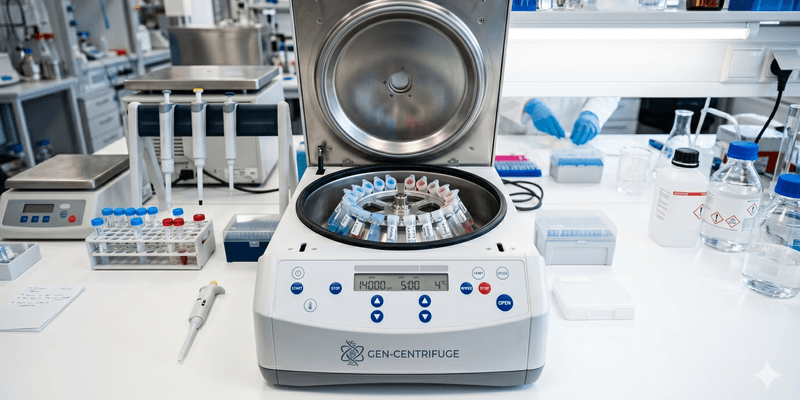
Start With Your Lab’s Throughput and Tube Needs
How many samples must be processed each day, and what tube types and volumes are routinely used? The lab assesses daily throughput and tube inventory to define centrifuge capacity. Decision-makers tally typical and peak sample counts https://laballiance.com.my/, noting tube formats—microtubes, conicals, blood collection tubes—and volumes from 0.2 mL to 50 mL.
They map routines to rotor options: fixed-angle or swing-bucket, and to available adapters for varied tube diameters. The aim is equipment that matches sample flow without overpaying for unused capacity, preserving workflow flexibility.
Consideration of batch vs. continuous processing guides rotor size and drawer layout. A clear specification of throughput and tube compatibility guarantees procurement aligns with operational freedom, minimizing future constraints.
Match Speed and RCF for Benchtop Centrifuges
Why match rotor speed to required relative centrifugal force (RCF)? A clear understanding ensures samples are processed efficiently without compromising integrity. RCF, not RPM alone, determines sedimentation; different rotor radii change the RCF delivered at a given RPM.
Selecting a centrifuge that can reach and maintain the needed RCF for intended applications gives operators the flexibility to run diverse protocols reliably.
Users seeking operational freedom should prioritize models with accessible speed controls, accurate RCF readouts, and safety interlocks that permit confident adjustments. Matching capability to protocol requirements avoids over- or under-spinning, preserves sample quality, and reduces trial-and-error.
This pragmatic alignment of speed and force streamlines workflows and broadens experimental options.
Choose Rotors and Tube Compatibility (Fixed-Angle vs Swing-Bucket)
Selecting the appropriate rotor and tube combination is essential because rotor geometry and tube compatibility directly affect separation efficiency, sample volume capacity, and experiment safety.
Fixed-angle rotors hold tubes at a set angle, providing rapid pelleting and higher apparent RCF for compact separations. They suit small volumes, dense pellets, and workflows favoring speed and throughput.
Swing-bucket rotors allow tubes to swing to a vertical position during spin, yielding cleaner gradient separations and intact banding for density or delicate fractionation. However, they occupy more space and run slower for equivalent RCF.
Tube material, dimensions, and adapter availability must match rotor specifications to preserve balance and chemical compatibility.
Choosing between them aligns with desired flexibility: prioritize fixed-angle for efficiency, swing-bucket for resolution and gentle layering.
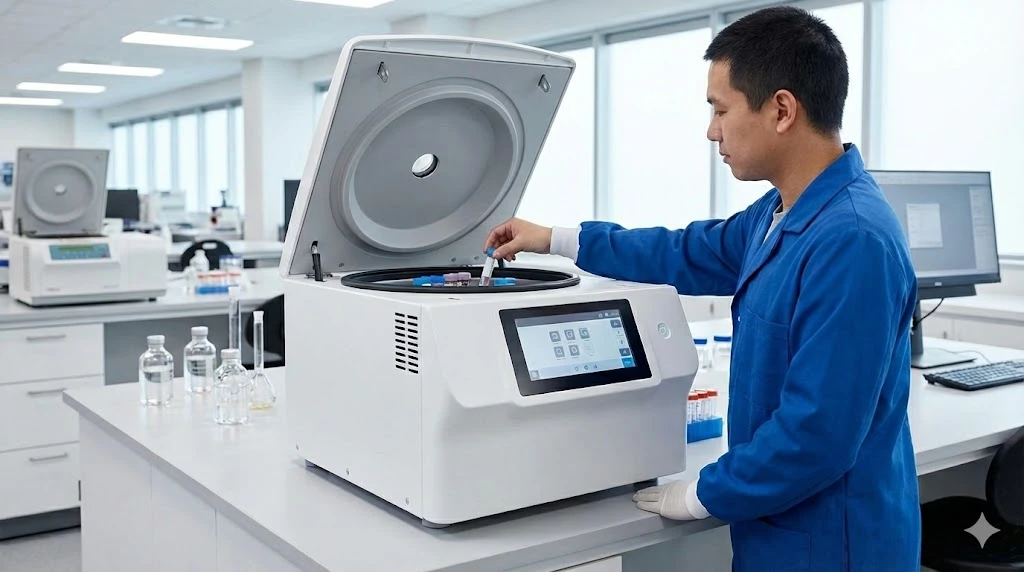
Operational Safety, Noise & Maintenance for Benchtop Centrifuges
After choosing the appropriate rotor and tube combination, attention must turn to operational safety, noise control, and maintenance to preserve performance and protect personnel. The user should expect clear safeguards: interlocks, imbalance detection, and validated SOPs that allow autonomy while reducing risk.
Noise affects concentration and comfort; selecting low-vibration models and placing units on dampening pads sustains a quieter workspace without restricting workflow.
Regular maintenance extends life and ensures reliable results: calibrate speed, inspect seals, and lubricate bearings per manufacturer guidance.
Consider these priorities:
- Verify and test safety interlocks, imbalance sensors, and emergency stop routines regularly.
- Implement vibration isolation and monitor decibel levels to maintain a permissive environment.
- Schedule routine inspections, component replacements, and speed/temperature verifications.
Compare Features, Warranty & Total Cost of Ownership
While performance specifications drive immediate suitability, long-term value hinges on a careful comparison of features, warranty provisions, and total cost of ownership. The evaluator should catalogue essential features—rotor types, speed ranges, programmability, footprint, and consumable compatibility—prioritizing modularity that preserves future autonomy.
Warranty scope and duration reveal manufacturer confidence: compare parts, labor, and failure exclusions, plus service response times and on-site support options.
Calculate total cost by summing purchase price, expected maintenance, consumables, energy use, and downtime risks; model costs over a realistic service life. Favor vendors offering transparent service agreements and upgrade paths to avoid vendor lock-in.
Clear, disciplined comparisons empower labs to choose centrifuges that maximize operational freedom and fiscal responsibility.
Conclusion
Selecting the ideal benchtop centrifuge requires balancing throughput, tube types, and required RCF to guarantee reliable sample processing. Rotor choice—fixed-angle or swing-bucket—must align with experiment goals and tube compatibility. Practical considerations such as safety features, noise levels, and maintenance needs affect daily usability, while warranty, features, and total cost of ownership determine long-term value. Thoughtful evaluation of these factors leads to a centrifuge that supports lab efficiency, accuracy, and safety.
…